
The products you are looking for are no longer manufactured by Intel. Additionally, Intel no longer provides interactive support for these products via telephone or e-mail, nor will Intel provide any future content updates or software updates to support new operating systems or improve compatibility with third party devices and software products.
THESE PRODUCT SUPPORT DOCUMENTS ARE PROVIDED FOR HISTORICAL REFERENCE ONLY AND ARE SUBJECT TO THE TERMS SET FORTH IN THE "TERMS OF USE" INFORMATION.
Information on currently available Intel products is available at www.intel.com and/or developer.intel.com
- Documents and Guides
-
- 400 and 450 MHz Pentium II Xeon datasheet
-
End of Interactive Support
Intel is announcing the end of interactive support for the Pentium® II Xeon® processors. See the End of Interactive Support Announcement for details.
The Intel® Pentium® II Xeon® processor is designed for mid-range to high-end servers and workstations, and is binary compatible with previous Intel Architecture processors. The Pentium® II Xeon processor provides the best performance available for applications running on advanced operating systems such as Microsoft Windows* 95, Microsoft Windows* NT, and UNIX*. The Pentium® II Xeon® processor is scalable to four processors in a multiprocessor system and extends the power of the Pentium® Pro processor with new features designed to make this processor the right choice for powerful workstation, advanced server management, and mission-critical applications. Pentium II Xeon processor-based workstations offer the memory architecture required by the most demanding workstation applications and workloads. Specific features of the Pentium II Xeon processor address platform manageability to meet the needs of a robust IT environment, maximize system up time and ensure optimal configuration and operation of servers. The Pentium II Xeon processor enhances the ability of server platforms to monitor, protect, and service the processor and its environment. Intel® Pentium® II Xeon® Processor [PDF]
  File Name: 24377003.PDF Size: 1002010 bytes Date: June 1998
- Intel® Pentium II Xeon Specification update
-
End of Interactive Support
Intel® is announcing the end of interactive support for the Pentium® II Xeon® processors. See the End of Interactive Support Announcement for details.
This document is an update to the specifications contained in the Pentium® II Xeon® Processor at 400MHz datasheet (Order Number 243770-001). This document is intended for hardware system manufacturers and software developers of applications, operating systems, or tools. It contains specification changes, S-specs, errata, specification clarifications, and documentation changes. The Pentium® II Xeon® processor may contain design defects or errors known as errata which may cause the product to deviate from published specifications. Current characterized errata are available on request.
- Specification Changes are modifications to the current published specifications. These changes will be incorporated in the next release of the specifications.
- S-Specs are exceptions to the published specifications, and apply only to the units assembled under the S-spec.
- Errata are design defects or errors. Errata may cause the Pentium® II Xeon® processor's behavior to deviate from published specifications. Hardware and software designed to be used with any given stepping must assume that all errata documented for that stepping are present on all devices.
- Specification Clarifications describe a specification in greater detail or further highlight a specification's impact to a complex design situation. These clarifications will be incorporated in the next release of the specifications.
- Documentation Changes include typos, errors, or omissions from the current published specifications. These changes will be incorporated in the next release of the specifications.
The Specification Update should be publicly available following the last shipment date for a period of time equal to the specific product's warranty period. Hardcopy Specification Updates will be available for one (1) year following End of Life(EOL). Web access will be available for three (3) years following EOL. Product Specification [PDF] Size: 24377632.PDF Size: 289963 bytes Date: January 2002
- Thermal management
-
End of Interactive Support
Intel is announcing the end of interactive support for the Pentium® II Xeon® processors. See the End of Interactive Support Announcement for details.- Introduction
- Thermal Management
- Integrated Heatsink
- System Airflow
- Thermal Testing (System Checkout)
- Testing Hints
This document is written for professional system integrators building PCs from industry-accepted motherboards, chassis, and peripherals. It provides information and recommendations for thermal management in systems using boxed Intel® Pentium® II Xeon™ processors.
It is assumed that the reader has a general knowledge of and experience with workstation and server operation, integration, and thermal management.
All systems using Pentium II Xeon processors require thermal management. In this case, "thermal management" includes two major elements: (1) a heatsink properly mounted to the processor and (2) effective airflow through the system chassis. The ultimate goal of thermal management is to keep the processor at or below its maximum operating temperature. Table 1 shows the maximum operating temperatures of specific Pentium II Xeon processors. The maximum operating temperature is measured at the center of the surface of the processor's thermal plate and varies depending on the particular frequency and stepping of the processor.
Proper thermal management is achieved when heat is transferred from the processor to the system air, which is then vented out of the system. Boxed Pentium II Xeon processors are shipped with an attached passive heatsink, which requires system airflow to effectively transfer processor heat to the system air. It is the responsibility of the system integrator to ensure adequate system airflow.
This document makes recommendations for achieving good system airflow.
Boxed Pentium II Xeon processors are shipped with an attached heatsink. The processor and heatsink should be used following the directions contained within the boxed Pentium II Xeon processor installation notes. Figure 1 shows the processor and heatsink.

Figure 1. Boxed Pentium® II Xeon® Processor and Heatsink
The heatsink that ships with the boxed Pentium II Xeon processor has already been securely attached to the processor. A small amount of thermal grease (already applied) provides effective heat transfer from the processor to the heatsink. The heatsink requires sufficient system airflow in order to keep the processor cool.
Some retention mechanisms supplied with Pentium II Xeon processor based motherboards provide locations for mounting small fans that draw air through the heatsink's cooling fins. Figure 2 shows an example of a second Pentium II Xeon processor being installed in a dual retention mechanism (DRM). In this example, two small fans are installed in the DRM. The fans ensure airflow over the cooling fins of the second processor's heatsink. Note that, unlike the second processor, the first processor has no fans directly drawing air across its heatsink. The system must provide adequate airflow to cool the first processor, which is without its own fan. The DRM fans must draw hot air from both processors out of the chassis. Check with your motherboard manufacturer for details about retention mechanisms and cooling solutions.

Figure 2. Boxed Pentium® II Xeon™ Processor Being Installed into Dual Retention Mechanism (DRM)
System airflow is determined by:
- Chassis design
- Chassis size
- Location of chassis air intake and exhaust vents
- Power supply fan capacity and venting
- Location of processor(s) slots
- Placement of add-in cards and cables
Integrators use two basic motherboard-chassis-power supply form factors: ATX and the older Baby AT form factor. Due to cooling and voltage considerations, Intel recommends the use of ATX form factor motherboards and chassis for the boxed Pentium II Xeon processor.
The ATX form factor simplifies assembly and upgrading of PCs, while improving the consistency of airflow to the processor. On ATX motherboards, the processor slot is located close to the power supply, rather than to the front panel of the chassis. This increases air circulation flowing directly across the processor. System component heat is dissipated into the chassis environment that is exhausted out while fresh air is brought in. Figure 3 below shows an example of typical airflow through an ATX system. Intel recommends ATX chassis that comply with the ATX 2.01 specification found on the ATX Web site. The ATX Web site also lists chassis manufacturers.

Figure 3. System Airflow through ATX Tower Chassis (side view)
The following is a list of guidelines to be used when integrating a system.
- Provide sufficient air vents: Systems must have adequate air vents in addition to a fan. Chassis vents must be fully functional. System builders should be careful not to select chassis that contain cosmetic vents only. Proper location of vents results in a good stream of air flowing over the processor.
- Power supply air flow direction: It is important to choose a power supply with a fan that moves air in the proper direction. For most ATX systems, the power supply acts as an intake fan, pushing air out of the system.
- Power supply fan strength: For some chassis that are running too warm, changing to a power supply with a stronger fan can greatly improve airflow.
- System fan--should it be used? Some chassis may contain a system fan to assist airflow. A system fan is typically used with passive heatsinks. In some situations, a system fan greatly improves system cooling. Thermal testing both with a system fan and without the fan will reveal which configuration is best for a specific chassis.
- System fan airflow direction: When using a system fan, ensure that it moves air in the same direction as the overall system airflow. A system fan in an ATX system should act as an exhaust fan, moving additional system air out through the exhaust vents in the chassis.
- Protect Against Hot Spots: A system may have a strong airflow, but still contain "hot spots." Hot spots are areas within the chassis that are significantly warmer than the rest of the chassis air. Such areas can be created by improper positioning of the exhaust fan, adapter cards, cables, or chassis brackets and subassemblies blocking the airflow within the system. To avoid hot spots, place exhaust fans as needed, reposition full-length adapter cards or use half-length cards, re-route and tie cables, and ensure space is provided around and over the processor.
Differences in motherboards, power supplies, add-in peripherals, and chassis all affect the operating temperature of systems and the processors that run them. Thermal testing is highly recommended when choosing a new supplier for motherboards or chassis, or when starting to use new products. Thermal testing can determine if a specific chassis-power supply-motherboard configuration provides adequate airflow for boxed Pentium II Xeon processors. To begin determining the best thermal solution for your Pentium II Xeon processor based systems, contact your motherboard vendor for chassis and fan configuration recommendations.
Use the following hints to reduce the need for unnecessary thermal testing.
- When testing a system that supports more than one processor speed, test using the processor(s) that generates the most power. Processors that dissipate the most power will generate the most heat. By testing the warmest processor supported by the motherboard you can avoid additional testing with processors that generate less heat with the same motherboard and chassis configuration.
Power dissipation varies with processor speed and silicon stepping. To ensure selection of the appropriate processor for your system thermal testing, refer to Table 1 for power dissipation numbers for boxed Pentium II Xeon processors. Boxed Pentium II Xeon processors are marked with a 5-digit test specification number, usually beginning with the letter S. Test specification numbers for a particular stepping of Pentium II Xeon processor can be found in the Pentium® II Xeon® Processor Specification Update, Order No. 243776.
Table 1. Boxed Pentium® II Xeon® Processor InformationProcessor Core Speed (MHz) and L2 Cache Size Boxed Pentium® II Xeon® Processor Stepping Maximum Thermal Plate Temp (°C) Power Dissipation (W) 400/512KB B0/B1 75 30.8 400/1MB B0/B1 75 38.1 450/512KB B1 75 34.5 450/1 MB B1 75 42.8 450/2 MB B1 75 46.7 - Thermal checkout with a new motherboard is not necessary if all of the following conditions are met:
- The new motherboard is used with a previously tested chassis that worked with a similar motherboard
- The previous test showed the configuration to provide adequate airflow
- The processor is located in approximately the same place on both motherboards
- A processor with the same or lower power dissipation will be used on the new motherboard
- Most systems are upgraded (additional RAM, adapter cards, drives, etc.) sometime during their life. Integrators should test systems with some expansion cards installed in order to simulate a system that has been upgraded. A thermal management solution that works well in a system that is heavily loaded does not need to be re-tested for lightly loaded configurations.
- Introduction
- Introduction and overview
-
End of Interactive Support
Intel is announcing the end of interactive support for the Pentium® II Xeon® processors. See the End of Interactive Support Announcement for details.
The Pentium® II Xeon® processor is available at 400 and 450 MHz in a new family of branded Intel processors specifically designed to meet the demands of mid-range and higher servers and workstations. To meet these demands, the Pentium II Xeon processor combines several premium characteristics: the architectural compatibility of previous Intel microprocessor generations; the Dynamic Execution and Dual Independent Bus architecture of the P6 microarchitecture found in the Pentium® II processor; and several new features designed to make this processor the right choice for powerful workstations, advanced server management and business-critical applications.The Pentium II Xeon processor at 400 MHz is available in 512K and 1 MB L2 cache options, and the Pentium II Xeon processor at 450 MHz is available in 512K, 1 MB, and 2 MB L2 cache options.
The Pentium II Xeon processor improves upon the Pentium Pro processor by adding MMX™ technology for 3-D compute-intensive applications, and by utilizing the S.E.C. (Single Edge Contact) cartridge package technology first introduced on the Pentium II processor.
Like the Pentium Pro processor, level 2 cache communication occurs at the full processor core speed.
A significant feature of the Pentium II Xeon processor, from a system perspective, is the built-in direct multiprocessing support. The Pentium II Xeon processor supports both uniprocessor and multiprocessor implementations with up to four processors on each local processor bus, or system bus.
The Pentium II Xeon processor system bus operates using GTL+ signaling levels with a new type of buffer utilizing active negation and multiple termination. This new bus logic is called Assisted Gunning Transistor Logic, or AGTL+.
Product Overview
- Power and performance for mid-range and higher servers and workstations.
- Available at operating frequencies of 450 MHz or 400 MHz
- 32KB (16KB data /16KB instruction) non-blocking, Level One (L1) cache provides fast access to heavily used data
- Dual Independent Bus (D.I.B.) architecture increases performance and provides more data to the processor core
- 100 MHz system bus speeds data transfer between the processor and the system
- 400 MHz offers 1 MB and 512 KB L2 cache options. 450 MHz offers 2 MB, 1 MB, and 512 KB L2 cache options.
- Level 2 cache bus operating at same speed as processor core provides new level of peak bandwidth to the processor
- Cacheable address space up to 64GB
- "Glueless" multiprocessing support for up to four processors
- Supports 8-way and beyond systems through other clustering technologies
- Intel® Extended Server Memory Architecture--expanded 36-bit memory support which allows operating systems and applications to utilize memory greater than 4 Gbytes
- Thermal sensor allows system to actively manage thermal conditions
- Error Checking and Correction (ECC) to maintain the integrity of mission-critical data
- Functional Redundancy Checking (FRC) to confirm processing integrity
- System Management Bus (SMBus) for efficient communications between the processor thermal sensor, processor-specific PIROM, OEM-writable EEPROM and the rest of the system
For more information, refer to the Intel Pentium II Xeon processor datasheet.
- Processor steppings
-
End of Interactive Support
Intel is announcing the end of interactive support for the Pentium® II Xeon® processors. See the End of Interactive Support Announcement for details.
B0-step versions of the Pentium® II Xeon® processor 400 MHz and B1-step versions of the boxed Pentium II Xeon processor 450 MHz should be used only in Intel® 440GX AGPset based systems. To distinguish between processor steppings, see How to Match Processor Steppings which lists processor steppings and their test specifications.
- Intel® microprocessor export compliance metrics
-
Intel Corporation
2200 Mission College Blvd.
P.O. Box 58119
Santa Clara, CA 95052-8119
USAGlobal Trade Department
e-mail inquiries to: ctp.determinations@intel.comFollowing are the Gigaflops (GFLOPS), Composite Theoretical Performance (CTP), and Adjusted Peak Performance (APP) values for Intel’s 32-bit and 64-bit processors. All Intel® 8-bit and 16-bit processors and microcontrollers with a clock speed exceeding 25 MHz are 3A991, with the exception of those encapsulated in military packages that have been tested to the Mil-883C temperature specifications. All Intel 8-bit and 16-bit processors and microcontrollers with a clock speed of 25 MHz or less are EAR99.
On November 5, 2007, the United States Department of Commerce’s Bureau of Industry and Security (BIS) published amendments to the Export Administration Regulations 15 CFR, which resulted in the inclusion of the December 2006 Wassenaar Arrangement Plenary Agreement Implementation.
The amendments introduced a new metric, Gigaflops (GFLOPS), to measure processor performance for export purposes. BIS no longer requires exporters to determine the CTP. However, CTP values will still be provided for those customers located in countries where the CTP is still required as a measurement of processor performance for export compliance purposes.
CTP calculations are based upon a modified formula resulting from Wassenaar negotiations on December 21, 1993, and published in the United States Department of Commerce Export Administration Regulations 15 CFR 774 (Advisory Note 4 for Category 4), and are stated in Millions of Theoretical Operations Per Second (MTOPS).
APP calculations are based on the formula published in the United States Department of Commerce Export Administration Regulations 71 CFR 20876, and are stated in Weighted Teraflops (WT).
All GFLOPS, CTP and APP calculations contained herein were based on specifications taken from Intel datasheets and are subject to change without notice. Intel makes no representation or warranty as to the accuracy or reliability of such specifications. THESE CALCULATIONS ARE PROVIDED "AS IS" WITH NO WARRANTIES WHATSOEVER, INCLUDING ANY WARRANTY OF MERCHANTABILITY, NONINFRINGEMENT, FITNESS FOR ANY PARTICULAR PURPOSE OR ANY WARRANTY OTHERWISE ARISING OUT OF ANY PROPOSAL, SPECIFICATION OR SAMPLE. Intel disclaims all liability, including liability for infringement of any proprietary rights, relating to use of information in these calculations. No license, express or implied, by estoppel or otherwise, to any intellectual property rights is granted herein.
Intel® Pentium® II Xeon® processorProcessor Number Clock Speed CTP in MTOPS GFLOPS APP in WT 1 Way 2 Way 4 Way N/A 450 MHz 525.002 0.45 0.000135 0.00027 0.00054 N/A 400 MHz 466.668 0.4 0.00012 0.00024 0.00048 N/A 350 MHz 408.334 0.35 0.000105 0.00021 0.00042 N/A 333 MHz 388.889 0.33 9.99E-05 0.0002 0.0004 N/A 300 MHz 350.001 0.3 0.00009 0.00018 0.00036 N/A 266 MHz 311.112 0.27 7.98E-05 0.00016 0.000319 N/A 233 MHz 272.223 0.23 6.99E-05 0.00014 0.00028
- Software and Drivers
-
- Download (Bootable Version) - Intel® Processor Frequency ID Utility
-
Version 7.2

The bootable version of the Intel® Processor Frequency ID Utility is available in .exe format. This download does not work in DOS-emulation windows, as found in operating systems such as Linux*. Since this version is bootable, it does not depend on any specific operating system (OS independent).
See the Installation Guide for detailed instructions on how to use this utility.
Which Utility Should I Use?
For Intel® Pentium® III processors, and processors manufactured before the Intel® Pentium® III processor, use the Intel® Processor Frequency ID Utility.
- Download (Windows* Version) - Intel® Processor Frequency Utility
-
Version 7.2
The utility is available for download in a self-installing .msi file format.
- Supported Processors
- Supported Operating Systems
You must have system administrative rights for successful installation on Windows XP* and Windows 2000*.Note There are two processor identification utilities used to identify Intel® processors. The Intel® Processor Identification Utility is the newest identification utility. Before downloading either utility, review the supported processors list to see the processors supported by each utility.
- Frequency Test Tab
-
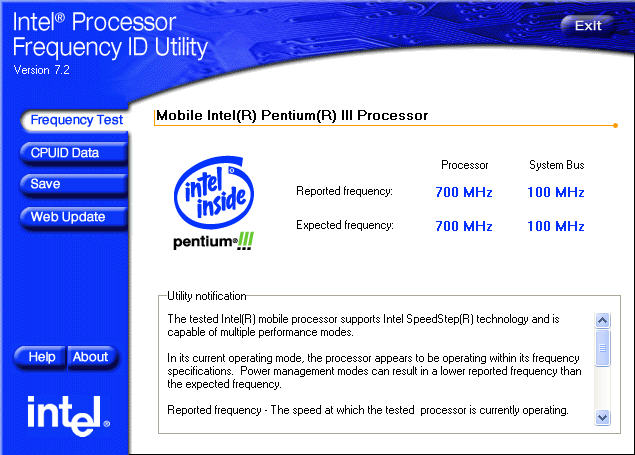
The Frequency Test Tab can provide information regarding the operating status of the tested processor or system bus. It will report:- Proper Intel® processor brand identification
- Processor and system bus expected frequencies
- Processor and system bus reported frequencies
- Accompanying this information is a message informing the user whether the processor is operating at its expected frequency
- Which processor was tested in a multiprocessor system, and total number of processors (Windows* XP, and Windows* 2000 only)
- Intel® Processor Frequency ID Utility for Windows*
-
The CPUID Utility for Windows* is incorporated into the Intel® Processor Frequency ID Utility.
Use the CPUID Data Screen of the utility to identify Pentium® processors and higher.
- Supported operating systems for the Intel® Processor Frequency ID Utility
-
Operating System
- Windows 98* SE
- Windows 2000* Professional, Server, Advanced Server
- Windows Me*
- Windows XP*
Note Windows 95*, Windows 98, Windows NT* 3.51, and Windows NT 4.0 are no longer supported. Use bootable version of the Intel Processor Frequency ID Utility for systems which have Windows 95 or Windows NT 3.51 installed.
- Intel® Processor Identification Utility download for Windows*
-
This utility is designed to identify current Intel® Processors and technologies, and enables you to run and save a processor ID report. The utility also features a frequency test to make sure that the processor is working at the tested and rated speed.
The Intel® Processor Identification Utility video walks you through download to installation, and provides an overview of the most common technologies supported by the processor.
The latest version of Intel® Processor Identification Utility is available for download in a self-installing .msi file format.
Note Microsoft Windows XP* and Microsoft Windows 2000* users must have system administrator rights to install the utility.
- Installation and Use
-
- Installation flyer for Intel® Pentium® II Xeon® Processors
-
The installation manuals and flyers for boxed processors are now available in 11 languages: English, Traditional Chinese, Simplified Chinese, Korean, French, Italian, German, Spanish, Portuguese, Russian, and Japanese.
Installation Flyer - English - PDF File Name: P2XPFLY1.PDF
Size: 5120 bytes
Date: 04/15/99
Installation Flyer - All Languages - EXE File Name: P2XPFLYA.EXE
Size: 1287168 bytes
Date: 04/15/99
- Installation manual for Pentium® II Xeon™ processors
-
The installation manuals and flyers for boxed processors are now available in 11 languages: English, Traditional Chinese, Simplified Chinese, Korean, French, Italian, German, Spanish, Portuguese, Russian, and Japanese.
The localized language versions are bundled together in one self-extracting .exe file. To get a specific language, you will need to download the bundled .exe file to your hard drive, and then double click on it to extract the individual language versions.Installation Notes - English - PDF File Name: P2XPMAN1.PDF
Size: 202752 bytes
Date: 04/15/99Installation Notes - All Languages - EXE File Name: P2XP11.EXE
Size: 5251072 bytes
Date: 04/15/99
- Integration Notes
-
Updated January 1999
This overview is for professional system integrators building workstations and mid range and higher servers with Intel® Pentium® II Xeon® processors and industry-accepted motherboards, chassis, and peripherals.
- Pentium II Xeon Processor Features
- Boxed Pentium II Xeon Processor Contents
- Motherboard Selection
- Chassis Selection
- Processor Connector Requirements
- Voltage Requirements
- Thermal Management Considerations
- BIOS Considerations
- Dual and Multi-Processor System Considerations
- How to Match Processor Steppings
- Mixing Processor Steppings and Speeds
Pentium II Xeon Processor Features
The Pentium II Xeon at 400 MHz processor is Intel’s first member of the new Intel Inside microprocessor family designed exclusively for today’s powerful servers and workstations. The Pentium II Xeon 450MHz processor is Intel’s second member. Building on the architecture of the Pentium II processor, the Pentium II Xeon processor adds the superior performance, manageability, and mission-critical reliability that your Intel-based servers and workstations demand.
The Pentium II Xeon processor delivers industry leading performance from its larger and faster Level 2 (L2) caches, multiprocessing capabilities, and a 100 MHz system bus. Systems based on the Pentium II Xeon processor are scalable, with support for:
- Up to four processors using "glueless" multiprocessing capabilities
- Eight-way and above systems using clustering technologies like NUMA and VI architecture
- Greater than 4 GB of memory using expanded 36-bit addressing
Key features of the Pentium II Xeon processor include:
- 0.25 micron P6 microarchitecture core operating at 450 MHz and 400 MHz
- Dynamic Execution
- 400 MHZ offers 1 MB or 512 KB L2 cache options.
- 450 MHZ offers 2 MB, 1 MB, or 512 KB L2 cache options.
- L2 cache bus operating at the same speed as the processor core
- New system management features via the System Management Bus (SMBus)
Boxed Pentium II Xeon Processor Contents
- 450 MHz processor with 2 MB, 1 MB, or 512 KB L2 cache or 400 MHz processor with 512 KB or 1MB L2 cache
- Attached Passive Heatsink
- Installation Manual
- Certificate of Authenticity
- Intel Inside® Logo Sticker
- 3-year Limited Warranty
Motherboard Selection
Motherboards used with the Pentium II Xeon processors at 450 MHz and 400 MHz must meet Intel’s published processor specifications.
Motherboards used with the Pentium II Xeon processor 400 MHz must support a 100 MHz system bus. Motherboards based on Intel’s 82440GX and 82450NX chipsets support a 100 MHz system bus. Intel offers two boxed platforms (motherboard and chassis) combinations for system integrators building Pentium II Xeon processor systems: the MS440GX and the SC450NX.
NOTE: B0-step versions of the Pentium II Xeon processor 400 MHz and B1-step versions of the boxed Pentium II Xeon processor 450 MHz should be used only in 82440GX based systems. To distinguish between processor steppings, see How to Match Processor Steppings which lists processor steppings and their test specifications.
Chassis Selection
Selection of a proper chassis is a very important consideration - particularly to ensure that proper venting and good airflow are present so that the processor does not exceed its thermal limits.
Integrators are encouraged to choose a chassis that will allow them to meet the thermal requirements of the processor. For assured compatibility, Intel’s two boxed motherboards supporting the Pentium II Xeon processor, the MS440GX and SC450NX, can be purchased complete with a chassis that will accommodate the motherboard.
Processor Connector Requirements
Motherboards supporting the Pentium II Xeon processor feature a 330-contact slot connector (previously called Slot 2) into which the processor is inserted. Processors using a 330-contact slot connector permit a closely coupled, high speed L2 cache, high-frequency signal integrity, and headroom for processor technology evolution.
Motherboards using a Pentium II Xeon processor require a mechanical support for the processor called a retention mechanism. The retention mechanism holds the processor securely in the 330-contact slot connector and protects the processor and motherboard from damage. Motherboards with a dual processor design typically require a dual retention mechanism. The single or dual retention mechanism is not included with the Boxed Pentium II Xeon processor. The single or dual retention mechanism should be provided, along with installation instructions, by your motherboard supplier. (All Intel boxed motherboards that support the 330-contact slot connector include an appropriate retention mechanism.) Figure 1 shows a second processor being installed in a dual retention mechanism.
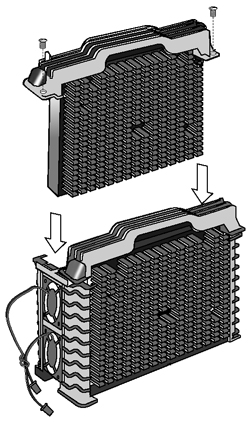
Figure 1.
Second Pentium II Xeon Processor and Heatsink Being Installed into a Dual Retention Mechanism
Voltage Requirements
The Pentium II Xeon processor core and L2 cache operate at different voltages. In order to support these different voltages the processor contains five voltage identification pins for the core and five for the L2 cache. The core and L2 cache are specified to operate at the following voltages:
Processor Frequency L2 Cache Size Processor Core Voltage L2 Cache Voltage Voltage Tolerance 400/512KB 2.0 V 2.5 V +/- 0.085 V 400/1MB 2.0 V 2.5 V +/- 0.085 V 450/512KB 2.0 V 2.7 V +/- 0.085 V 450/1 MB 2.0 V 2.7 V +/- 0.085 V 450/2 MB 2.0 V 2.7 V +/- 0.085 V
Proper voltage must be supplied for reliable operation. It may be supplied by a regulator(s) integrated in the motherboard or by a voltage regulator module (VRM) installed on the motherboard in a VRM header. Intel strongly recommends the use of the VRM header that meets the VRM 8.3 specification.
If the regulator is integrated in the motherboard, it must be Voltage ID (VID) programmable to allow the processor to program the correct voltage during power-on.
If the motherboard has a VRM 8.3 header, then a VRM must be installed in the header to power the associated processor (core and L2 cache). Most VRMs are VID-programmable. If your motherboard has a fixed-voltage VRM, its output voltage must match the processor requirements.
Since the operating voltage of Pentium II Xeon processors (both core and L2 cache) may be changed as the processor goes through stepping changes, VID-programmable voltage regulators are the preferred solution.
Thermal Management Considerations
The table below shows the maximum operating temperatures for Pentium II Xeon processors, measured at the center of the processor's thermal plate beneath the heatsink:
Processor Frequency and L2 Cache Size Processor Stepping Max. Operating Temp. in °C Total Max Processor Power in Watts 400/512KB B0/B1 75 30.8 400/1MB B0/B1 75 38.1 450/512KB B1 75 34.5 450/1 MB B1 75 42.8 450/2 MB B1 75 46.7
You must use a chassis that provides sufficient airflow to keep the processor under its maximum operating temperature in the warmest user environment. Running the processor above its maximum temperature specification will void the warranty and can lead to functional and performance degradation. Intel recommends the use of ATX 2.01-compliant motherboards and chassis for proper mechanical fit. The combination of the heatsink shipped with the Boxed Pentium II Xeon processor, an ATX form-factor motherboard and an ATX 2.01-compliant chassis can be a good thermal management solution. Be aware that the airflow in non-ATX 2.01-compliant chassis varies significantly - depending on venting, internal brackets and other factors. Chassis with low airflow can cause processors to run warmer than their maximum specification. Thermal evaluation should always be performed when selecting a chassis for Pentium II Xeon processor-based systems. Refer to Thermal Management for Pentium® II Xeon® Processor-Based PCs for more information.
BIOS Considerations
BIOS code on Pentium II Xeon processor-based motherboards contains data that is specific to a processor silicon stepping. (A silicon stepping is a specific revision of the silicon.) You must ensure that this stepping data matches the processor stepping used. When the stepping data doesn't match the processor stepping, you must update the data before shipping the system.
Motherboard vendors can supply information about the default stepping of the Pentium II Xeon processor supported by the BIOS on a specific motherboard. If the default stepping data does not match the processor stepping used, the motherboard vendor can supply a system BIOS upgrade for the motherboard. Make sure to specify the processor speed and stepping that you are currently using.
Dual and Multiple Processor System Considerations
In addition to single-processor use, the Pentium II Xeon processor is designed for dual and multiprocessor operation.
Pentium II Xeon processors are tested during manufacturing to ensure they will work in configurations with multiple processors of the same speed and same L2 cache sizes. While operation with different speed processors and different L2 cache sizes is not prohibited, it is not tested by Intel and could have implications when running with operating systems that support multiprocessing.
Intel tests dual processor configurations with different steppings of the Pentium II processor as new processor steppings are introduced. Certain Pentium II Xeon processors of the same speed but different steppings can be mixed in dual processor configurations, provided that the motherboard's BIOS will support this option. For more information, see Mixing Processor Steppings and Speeds below.
NOTE: B0-step versions of the Pentium II Xeon processor 400 MHz and B1-step versions of the boxed Pentium II Xeon processor 450 MHz should be used only in 82440GX based systems. To distinguish between processor steppings, see How to Match Processor Steppings which lists processor steppings and their test specifications.
Recommendations for Integration of Dual and Multiprocessor Systems:
- Ship multiprocessor systems with all processor slots populated to ensure that processor speeds, steppings, and L2 cache sizes are the same. When partially populated systems are shipped, customers attempting to install additional processors may have difficulty locating them with the same stepping or cache sizes. In these cases, they may have to replace the original processor to obtain a system with processors of the same stepping.
- Make sure that the correct motherboard BIOS is loaded into both processors. Contact your motherboard vendor if you have any questions on BIOS upgrades.
- If a system is shipped without all processors installed, test the system first with all processor slots populated. This will demonstrate whether the motherboard supports multiprocessor operation. You should also provide these customers with speed and stepping information for the original processor. This will ensure they understand the importance of having processors of the same speed, stepping, and cache size. It also warns them of the risk of having to replace the original processor in the future if earlier stepping processors are not available.
- If a system is shipped without all processors, install the operating system with all processors installed. Some operating systems will install different kernel versions, depending on the number of processors present. Once the operating system has been installed the remaining processors can be removed before system shipment. This alleviates the need to reinstall the operating system if more processors are added later. Make sure to populate all open processor connectors with appropriate termination cards which should have been supplied with your motherboard.
- Integrators thinking about mixing processor steppings within a multi-processor system should first read Mixing Processor Steppings and Speeds for an overview of the issues involved.
How to Match Processor Steppings
The easiest way to match steppings is to compare the 5-character test specification numbers on the top of Pentium II Xeon processors. The number starts with an "S" and is followed by 4 characters (for example, "SL2RH"). Boxed Pentium II Xeon processors have the test specification number also printed on the package label.
Identical silicon steppings may sometimes be shipped with different test specification numbers—depending on whether they are for OEMs or for system integrators. The following table shows comparisons of the two types of numbers (at this time there are no test specification differences to report). Some Intel boxed processors may have OEM test specification numbers.
Boxed Pentium II Xeon Processor Silicon Test Specification vs. OEM Test Specification
This information has been moved. See the Processor S-spec Table for detailed information.
Mixing Processor Steppings and Speeds
Though Intel recommends using identical steppings of processor silicon in multiprocessor systems whenever possible (as this is the only configuration which receives Intel's full testing), Intel supports mixing processor steppings and does not actively prevent various steppings of the Pentium II Xeon processor from working together in multiprocessor systems. However, since Intel cannot test every possible combination of devices, each new stepping of a device is fully tested only against the latest steppings of other processors and chipset components. For more details on mixing processor steppings in multiprocessor systems, see the Pentium II Xeon® Processor Specification Update.
The following list explains the known issues with mixing steppings:
- In mixed stepping configurations, all processors must be run at an identical frequency and must have the same L2 cache sizes
- The workarounds for various errata must take all processors into account. Errata for the Pentium II Xeon processor are published in the Pentium® II Xeon® Processor Specification Update.
- Errata for all processor steppings present in a system will affect that system, unless worked around.
- Some operating systems may not support full functionality when processors with mixed steppings are present. Check with your operating system vendor for details.
Due to the variety of motherboard vendors in the market and the number of system BIOS revisions, some system-level issues may occur that lie outside the realm of any mixed stepping evaluation performed by Intel. Recommendations for shipping systems that mix Pentium II Xeon processor steppings are as follows:
- Choose a motherboard vendor with a history of quality and dual and multiprocessor experience to minimize potential system-level issues
- Contact your motherboard vendor for information on mixed stepping validation performed on your particular dual or multiprocessor motherboard
- Make sure that the motherboard’s BIOS will support all processor steppings. As indicated in BIOS Considerations above, motherboard vendors should be able to supply information about the steppings of the Pentium II Xeon processor supported by the BIOS on a specific motherboard.
- Refer to the Pentium® II Xeon® Processor Specification Update for information on processor errata, their workarounds and potential performance issues before integrating dual and multiprocessor systems. The specification update (order number: 243776-xxx) can be obtained from Intel literature at 1-800-548-4725. The order number changes with each specification update; the -xxx numbers grow larger with each revision. Choose the highest revision number to receive the latest update.
Information about mixing processors of different speeds can be found in the Pentium® II Xeon® processor at 400 and 450 MHz Datasheet.
Additional information related to stepping, voltage and packaging of each specific Pentium II Xeon processor can be found in the Pentium® II Xeon® Product Specifications and Comparisons.
- Technical Notes
-
- Intel® 440GX AGPset AGTL+ layout guidelines
-
End of interactive support
Intel® is announcing the end of interactive support for the Pentium® II Xeon® processors. See the End of Interactive Support Announcement for details.
The Pentium® II Xeon® processor is a follow-on to the Pentium® Pro and Pentium® II processors and is the first 100 MHz Slot 2 processor. The Intel® 440BX AGPset and Intel® 440GX AGPset have been designed to provide a high-performance memory, Advanced Graphics Port (AGP), and I/O subsystem for Pentium II Xeon processor based systems. The Intel® 440BX AGPset integrates a memory controller that supports up to 1 Gbyte of main memory (Intel® 440GX AGPset supports up to 2 Gbyte). Product Information and Layout Guidelines [PDF] File Name: 24377501.PDF Size: 198286 bytes Date: June 1998
- Intel® 450NX PCIset AGTL+ layout guidelines
-
Product Information and Layout Guidelines (PDF)
This document discusses specific system guidelines, step-by-step methodology used to design Pentium II Xeon processor systems with Intel 450NX PCIset components, theories applicable to this layout guideline, and equations.
Filename: 24379001.pdf
Size: 197 KB
Date: June 1998
Product Information and Layout Guidelines (PDF)
This document discusses specific system guidelines, step-by-step methodology used to design Pentium II Xeon processor systems with Intel 450NX PCIset components, theories applicable to this layout guideline, and equations.
Filename: 24379001.pdf
Size: 197 KB
Date: June 1998
- Hardware developer's manual
-
End of interactive support
Intel is announcing the end of interactive support for the Pentium® II Xeon® processors. See the End of Interactive Support Announcement for details.
The P6 family of processors is the generation of processors that succeeds the Pentium® line of Intel processors. This processor family implements Intel's dynamic execution microarchitecture; which incorporates a unique combination of multiple branch prediction, data flow analysis, and speculative execution. This enables P6 family processors to deliver higher performance than the Pentium family of processors, while maintaining binary compatibility with all previous Intel Architecture processors. The P6 Family includes the Pentium® III Xeon® processor, Pentium® II Xeon® processor, Pentium® III Processor, Pentium® II processor, Pentium® Pro processor, Intel® Celeron® processor, Mobile Intel® Pentium® III processor, Mobile Intel® Celeron® processor, Mobile Intel® Pentium® II processor, and Mobile Pentium® processor. 24400101.PDF Size: 755412 bytes Date: September 1998
- Bus terminator design guidelines
-
The Intel® Pentium® II Xeon® processor includes termination circuitry for the microprocessor's Assisted Gunning Transceiver Logic (AGTL+) bus. In a multiple-processor system each processor location (slot connector) must be properly terminated, whether or not all locations have processors installed. This document describes design considerations for a termination card to occupy unused connector locations and terminate the bus.
These design guidelines include layout rules and hints based on system design experience. They do not define a specific card design nor constitute a specification. Card designers will still need an understanding of the system the card will be used in and will need to perform the customary simulation and system testing. 24514901.PDF Size: 113056 bytes Date: May 1999
- Design guides
-
CK97 Clock Synthesizer Design Guidelines [PDF] File Name: 243867.pdf
Size: 388,624 bytes
Date: June 1998
- These products are no longer supported via phone, e-mail, or chat
-
The following older processor families are no longer supported through interactive support such as phone, e-mail, or chat.
Intel will maintain information for these processors on our web site. You can access these processor family Web sites by clicking on the links under the processor column.
Processor End of interactive support (EOIS) Additional description Mobile Intel® Pentium® 4 Processors - M November 8th, 2008 All Intel® Processor Frequency ID Utility November 8th, 2008 All Intel® Pentium® Processors Extreme Edition November 8th, 2008 All Intel® Pentium® D Processors November 8th, 2008 All Intel® Pentium® 4 Processors Extreme Edition November 8th, 2008 All Intel® Pentium® 4 Processors Extreme Edition supporting HT Technology November 8th, 2008 All Intel® Pentium® 4 Processors November 8th, 2008 All Intel® Celeron® D Processors November 8th, 2008 All Intel® Celeron® Processors November 8th, 2008 All 478-pin package December 1st, 2004 All FCPGA & FCPGA2 packages December 1st, 2004 All 370-pin package June 14th, 2002 All PPGA & SEPP packages Still supported [E3000, E1000 & 400 Series are still supported] Intel® Pentium® III Xeon® Processors December 1st, 2004 All Intel® Pentium® III Processors December 1st, 2004 All Mobile Intel® Pentium® III Processors December 1st, 2004 All Intel® Pentium® II Xeon® Processors June 14th, 2002 All Intel® Pentium® II Processors June 14th, 2002 All Mobile Intel® Pentium® II Processors December 1st, 2004 All Intel® Pentium® Pro Processors October 17th, 2000 All Intel® Pentium® Processors with MMX™ Technology October 17th, 2000 All Intel® Pentium® Processors October 17th, 2000 All Intel® Pentium® Mobile Processors October 17th, 2000 All Intel® OverDrive® Processors October 17th, 2000 All Intel486™ Processors December 1st, 2004 All Intel386™ Processors December 1st, 2004 All